Saturday, April 25, 2009

Welcome to the family.

We have a hop vine in our yard which produced 4.5 lbs of hops last year. We call him Dennis Hopper. I felt he was lonely so I bought 2 more rhizomes this and installed them in our yard. Right across from Dennis we planted Mrs. Denise Hopper (Dennis and Denise are married).

Dennis is Willamette hop vine which produces a woody, earthy or herbal flavored hop. Sort of the west coast hippies of the hop world. Denise is a Tettnanger which produces a very sophisticated spicy aroma in beer. Many German lagers use Tettnanger hops which are grown in the Tettnang region of Germany. So far the language barrier has not affected Dennis and Denises budding romance (that's right, I made a gardening pun).

And in the back yard we planted Daniel Hasselhop. he was named by my wife and she insists you always use his full name. He will produce a very delicate hop with a floral aroma perfect for lagers. As a proud parent I like to show off baby pictures so here is the newborn Daniel Hasselhop just before planting. I can't wait until Daniel Hasselhop is a teenager and I can embarrass him in front of his friends by showing this baby picture.

Brew Session: Calico Common

Many beer drinkers on the west coast have heard of Anchor Steam Beer but most don't know that this style of beer is distinctly American invention. The name Steam Beer was widely used for the lagers being brewed in California around the time of the gold rush (1848-1855). Just prior to this time, lager had started seeing widespread distribution in Europe due to several advances in brewing technology which made producing this cold fermented beer cost effective. Soon, German brewers migrated to America and followed the flood of fortune seekers to the California Gold Rush.
The important thing to know about lager yeast is that it makes a very clean tasting beer when fermented at cold temperatures but at warm temperatures ferment pretty funky. Now, the brewers in California needed to make this beer fast and cheap and in the California heat so they didn't bother with the cold fermentation, probably because they had no other choice.
The result was a beer brewed with a lager yeast at warm temperatures called Steam Beer. It would most likely be unpalatable to a current day beer drinker. It was considered a cheap , poorly made beer for blue-collar working men of the time.
It was quite popular into the 1900s but soon died out when refrigeration became widespread and lager could be brewed at cold temperatures anywhere. Anchor Brewing Company makes a product called Steam Beer today and have trademarked the name (brewers call the style California Common now). It is debatable whether it is similar to the original.
I find the whole story to be quite American, a low quality, barely drinkable beer created to milk the most profit from an clientele that has no choice or doesn't know better then later on a enterprising brewer tries to capitalize on the kitsch value of the name.
The home brewed version is much better than the original as the California lager yeast has evolved since then to ferment very clean at the warmer temperatures. So, after all that dry history I present my Calico California Common recipe which uses Willamette hops I grew in my own yard and random hops from my freezer that were left over from other batches.

Calico Common

Recipe for 5.5 gallons
8.75 lbs Pale 2 Row Malt
1.00 lbs Munich Malt
5 oz Vienna Malt
3 oz Chocolate Malt
6 oz Willamette Hops at 60 minutes (these are from my yard and very low acid)
2 oz Saaz (3.0%) at 30 minutes
1 oz Strisselspalt (3.3%) at 10 minutes

I made a 3 quart starter using California Lager yeast and fermented at 60F for 2 weeks. Now I am just waiting for the bottle conditioning to finish, but the green beer tasted delicious.

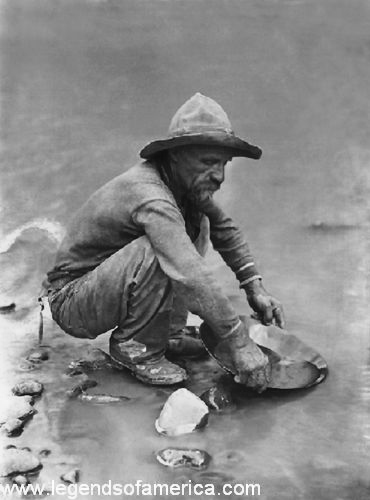
I have no pictures of the brew session so you will have to satisfy yourself with this picture of an old miner.

Sunday, March 15, 2009

Brew Session: Kolsch

Even though my experience is limited I love Kölsch. I was told by my German buddy that the word Kölsch means Cologne-ish or from Cologne ( Köln-ish depending on where your keyboard is from). In fact the Kölsch convention of 1986 states that Kölsch must be brewed in the Cologne region of Germany.

A glass of Kölsch is tall and beautiful, much like my German friend. It should be very bubbly, have thick crown of foam and served in a small (4-7oz) glass called a Stange. The people of Cologne must have a bubble fetish(who doesn't?). This tiny glass insures that beer is fresh from the tap and still has a lot of spritz in it.

This is a light bodied beer with a delicate malt/hop balance and quite a challenge for the home brewer. There is no place for any off-flavors to hide. It is much easier to make a roasty dark beer or a IPA bursting with hops than a delicate beer like this. This means a good tasting Kölsch has to be fussed over at every stage.

My first recipe (in the picture) was very similar to this one except I used wheat malt in place of Vienna and Carapils malts. This was a very tradition recipe from the 1800s and it turned out very tasty. In fact, this beer was included in the best of show at a local home brew fair. Nowadays, Kölsch is almost never brewed with wheat malt. Wheat lends a tangy quality which I haven't tasted in any of the versions I have tried so I modernized my recipe. During the first brewing it rained and on this brew day it hailed, hence the name.

Come Hail and High Water Kölsch

Recipe for 6 gallons
9.75 lbs German Pilsner Malt
0.75 lbs Vienna Malt
0.25 lbs Carapils Malt
1 oz Hallertau 3.3% @ 60 minutes
1 oz Saaz 3.0% @ 60 minutes
1 oz Saaz 3.0% @ 10 minutes

Mash in at 147F and hold for 60 minutes (the temperature actually wondered from 145-149F during brewing). Step up to 159F and hold for 15 minutes. Boil for 90 minutes. I do a modified batch sparge but any style show work. Ferment at 57-59F, then lager for a month.


The first picture here is just before the hail started pestering, you can see I put 2 kegs to good use as a table. The seconds picture is 2 days later when the fermentation was in full swing. Check out the foam on that baby and it has a nice aroma, this tells me the fermentation is very healthy.